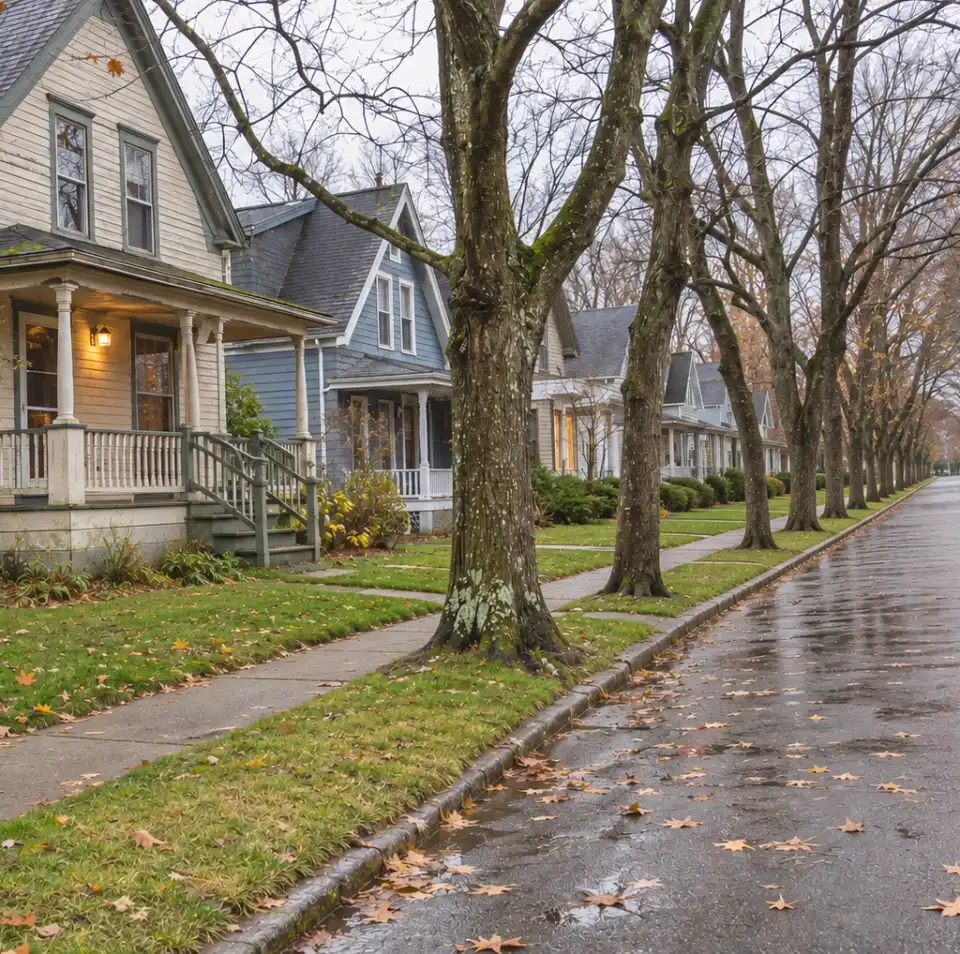
Syracuse gets 127.8 inches of snow in an average year, and its first 32°F night arrives around October 19, according to NOAA's 1991–2020 U.S. Climate Normals for the Hancock airport station. That leaves a frost-free window of about 173 days, and almost every outdoor pest problem in the city happens inside it. When that window closes, the problem moves indoors: the National Pest Management Association estimates that rodents invade about 21 million U.S. homes each winter. Bed bugs follow neither pattern. They live indoors with people all year, and their reports peak in late summer.
How to read this calendar: temperatures, humidity and freeze dates come straight from NOAA station data. Pest timing comes from the agencies and studies linked in each section. The pressure levels in the matrix are our reading of those sources, set against Syracuse's climate. They are not counts of service calls. Where a source describes another region (downstate New York or Philadelphia, for example), the text says so.
- Syracuse averages 24.1°F in January and 71.8°F in July, with 127.8 inches of snow and 39.88 inches of precipitation a year (NOAA NCEI).
- The median last spring freeze is April 29 and the median first fall freeze is October 19 (NOAA NCEI).
- Rodents invade an estimated 21 million U.S. homes each winter, and 24% of homeowners report mice specifically in winter (NPMA).
- 14.8 million U.S. homes (11.9%) reported seeing rodents in a year, and sightings are more common in the Northeast (U.S. Census Bureau).
- Mosquitoes are active "from early summer until late fall" in New York State, and about 70 species live here (NYS Department of Health).
- Onondaga County sprayed Cicero Swamp from the air in 2019, 2024 and 2025 after mosquitoes tested positive for EEE and West Nile virus (Onondaga County Health Department).
- Mosquito barrier spray costs $70–$150 a visit (Angi); most homeowners spend $200–$550 per treatment or season.
- 35% of ticks tested by SUNY Upstate's tick lab in 2025 carried the Lyme bacteria (Syracuse.com).
- New York reported more than 19,000 Lyme disease cases in 2023 (NYS Department of Health).
- Termites swarm from March through June in New York, mostly on warm days after rain (Cornell Cooperative Extension; NC State Extension).
- Stinging insects send more than 500,000 people to the emergency room each year and are most active in late summer and early fall (NPMA).
- Bed bug reports in a Philadelphia study peaked in August and bottomed out in February (Journal of Medical Entomology).
- 51% of pest professionals say summer is the peak bed bug season, and 45% have found bed bugs in college dorms (NPMA via PCT).
- Syracuse University enrolled 21,922 students in fall 2025, and new students moved in August 17–19, 2026 (Syracuse University).
1. Syracuse Climate in Numbers
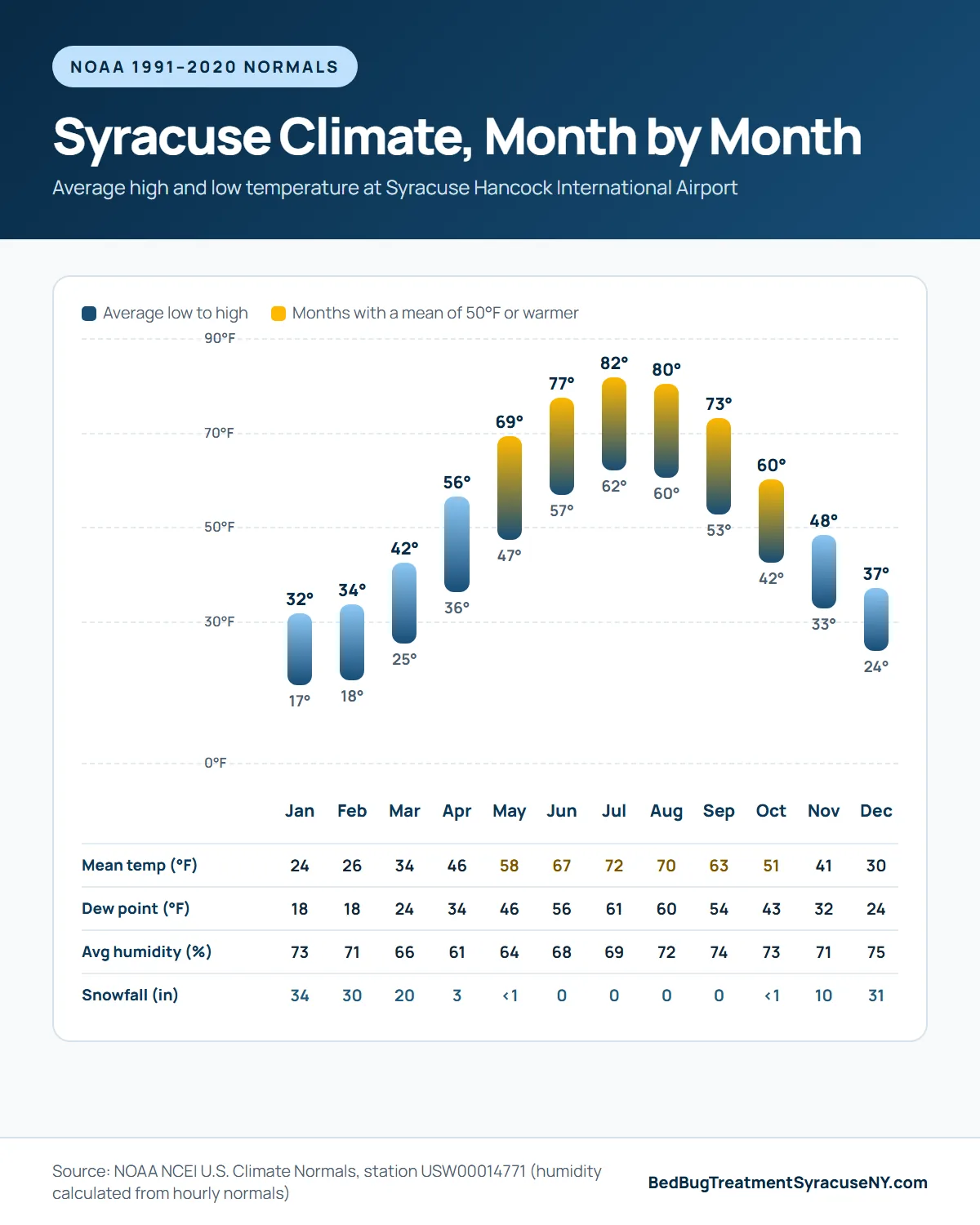
Insects are cold-blooded, so local temperature sets their calendar. The figures below are NOAA's official 1991–2020 normals for Syracuse Hancock International Airport (station USW00014771), the 30-year averages the National Weather Service uses to define a "normal" month. Humidity is not published as a monthly normal, so we calculated it from NOAA's hourly temperature and dew point normals.
| Month | Avg high | Avg low | Mean | Dew point | Humidity | Snow |
|---|---|---|---|---|---|---|
| January | 31.7°F | 16.5°F | 24.1°F | 17.5°F | 73% | 34.0 in |
| February | 33.6°F | 17.5°F | 25.5°F | 17.8°F | 71% | 30.3 in |
| March | 42.4°F | 25.2°F | 33.8°F | 23.7°F | 66% | 19.8 in |
| April | 56.4°F | 36.2°F | 46.3°F | 33.6°F | 61% | 3.0 in |
| May | 69.2°F | 47.3°F | 58.2°F | 45.7°F | 64% | 0.1 in |
| June | 77.3°F | 56.7°F | 67.0°F | 56.3°F | 68% | 0 |
| July | 81.7°F | 62.0°F | 71.8°F | 61.1°F | 69% | 0 |
| August | 80.3°F | 60.4°F | 70.4°F | 60.2°F | 72% | 0 |
| September | 73.1°F | 52.7°F | 62.9°F | 54.1°F | 74% | 0 |
| October | 60.1°F | 42.4°F | 51.3°F | 42.8°F | 73% | 0.2 in |
| November | 48.3°F | 32.7°F | 40.5°F | 32.0°F | 71% | 9.8 in |
| December | 37.1°F | 23.7°F | 30.4°F | 23.9°F | 75% | 30.6 in |
| Climate threshold | Syracuse value | Source |
|---|---|---|
| Days a year with a low of 32°F or below | 132 | NOAA NCEI (sum of monthly normals) |
| Days a year that never rise above 32°F | 47 | |
| Days a year reaching 90°F | 10 | |
| Annual mean temperature | 48.5°F | |
| Months with a mean of 50°F or warmer | 6 (May–October) | NOAA NCEI |
What it means: Syracuse has a short, humid growing season and a long, snowy winter. Six months average 50°F or warmer, and that is when outdoor pests build up. The other six push mice, cluster flies and stink bugs into wall voids and attics. Late summer and early fall are the most humid stretch, with average humidity of 72% to 74% from August through October.
2. The 12-Month Syracuse Pest Pressure Matrix
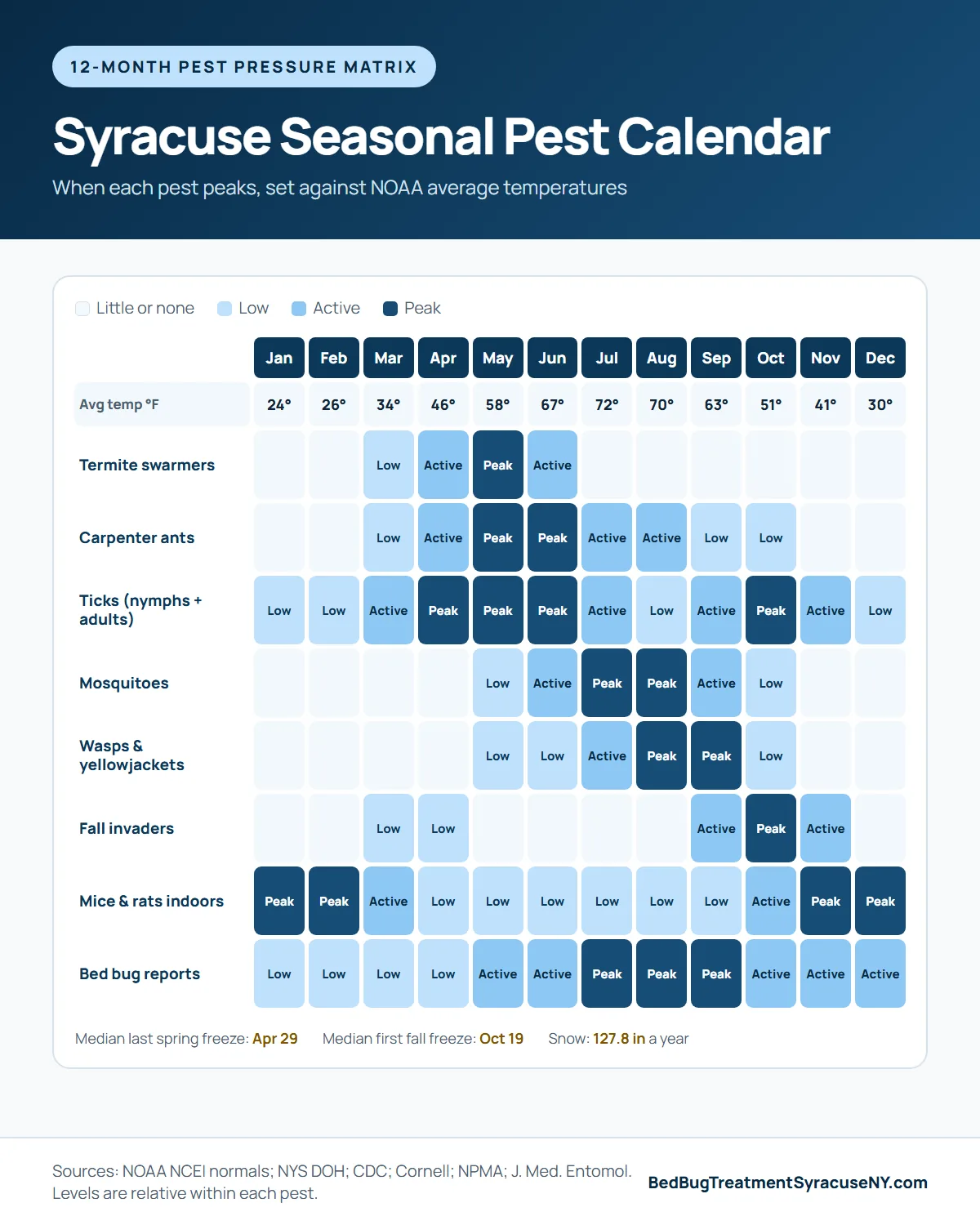
This matrix sets each pest's published activity window against Syracuse's monthly mean temperature. Read across a row to see when a pest peaks; read down a column to see what a given month brings. Levels compare months within each pest, not one pest against another.
| Pest | Jan | Feb | Mar | Apr | May | Jun | Jul | Aug | Sep | Oct | Nov | Dec |
|---|---|---|---|---|---|---|---|---|---|---|---|---|
| Mean temp | 24° | 26° | 34° | 46° | 58° | 67° | 72° | 70° | 63° | 51° | 41° | 30° |
| Termite swarmers | Low | Active | Peak | Active | ||||||||
| Carpenter ants | Low | Active | Peak | Peak | Active | Active | Low | Low | ||||
| Ticks (nymphs + adults) | Low | Low | Active | Peak | Peak | Peak | Active | Low | Active | Peak | Active | Low |
| Mosquitoes | Low | Active | Peak | Peak | Active | Low | ||||||
| Wasps & yellowjackets | Low | Low | Active | Peak | Peak | Low | ||||||
| Fall invaders | Low | Low | Active | Peak | Active | |||||||
| Mice & rats indoors | Peak | Peak | Active | Low | Low | Low | Low | Low | Low | Active | Peak | Peak |
| Bed bug reports | Low | Low | Low | Low | Active | Active | Peak | Peak | Peak | Active | Active | Active |
| Pest | Peak window | Climate trigger | Source |
|---|---|---|---|
| Termite swarmers | March–June | Warm days after rain | CCE Nassau; NC State |
| Carpenter ants (mating flights) | Late spring–early summer | Warming spring; earlier in heated buildings | CCE Rockland |
| Ticks | Spring, summer, fall; adults any time above freezing | Above freezing; mostly above 45°F | CDC; EPA |
| Mosquitoes | Early summer–late fall, until frost | Daily temps 50–95°F, humidity 42%+ | NYS DOH; Climate Central |
| Wasps and yellowjackets | Second half of summer–early fall | Colonies at full size | NPMA |
| Fall invaders | September–November | Cooling nights | Cornell NYS IPM |
| Mice and rats indoors | Fall and winter | First freeze (median Oct 19) | NPMA |
| Bed bug reports | July–September (all year indoors) | Travel, moving, warm rooms | J. Med. Entomol. |
How to use it: the matrix works as a prevention schedule. Seal gaps and screens in March and April before termites and ants fly. Deal with standing water in May before mosquitoes ramp up. Check for wasp nests in July while they are small. Close up the outside of the house in September before the October freeze. If you live in an older home in Tipp Hill, with its pre-1960 housing and many trim gaps, that fall sealing pays off twice: it keeps out mice and the stink bugs that overwinter in walls.
3. The Most Common Pests in Syracuse, NY
No agency publishes a pest-call ranking for Syracuse alone, so this section brings together the closest local and national counts. Rodents are the most widespread household pest by federal survey, ticks and mosquitoes carry the most disease risk in Onondaga County, and Syracuse ranks on the national bed bug list.
| Metric | Value | Source |
|---|---|---|
| U.S. homes that saw rodents in the past 12 months, 2019 | 14.8 million (11.9%) | U.S. Census Bureau, American Housing Survey |
| Highest metro rodent sighting rate (Philadelphia) | 18.9% | |
| Homes with wall problems vs. without, rodent sightings | 5.6× more likely | |
| U.S. homes invaded by rodents each winter | ~21 million | NPMA |
| Central New York ticks carrying the Lyme bacterium | 40%–50% | Onondaga County Office of the Environment |
| Mosquito species in New York State | About 70 | NYS DOH |
| Syracuse rank, Orkin 2026 Bed Bug Cities list | #44 (up 6) | Orkin |
| Pest pros who treated bed bugs in the past year | 97% | NPMA |
| Pest pros who found bed bugs in single-family homes / apartments | 91% / 89% | |
| Common fall invaders in the Northeast | 5 (lady beetles, boxelder bugs, seed bugs, cluster flies, stink bugs) | Cornell NYS IPM |
| Emergency room visits from stinging insects, per year | 500,000+ | NPMA |
The short answer: the most common pests in Syracuse follow the season. They are ants and termite swarmers in spring, mosquitoes, ticks and wasps in summer, stink bugs and lady beetles in fall, and mice all winter. Bed bugs are the exception that ignores the weather, which is why this site focuses on them. For what each of these costs to treat locally, see our Syracuse pest control cost index.
4. Spring: Termite Swarms and Carpenter Ants
The first winged insects of the year are often termites. Eastern subterranean termites send out swarmers, the winged reproductives, to start new colonies. Most homeowners only learn they have termites when a swarm comes out indoors. Cornell's published swarm windows are for downstate New York; no agency publishes a separate Syracuse calendar. Spring also comes later here, and the average high first tops 65°F in May.
| Metric | Value | Source |
|---|---|---|
| Termite swarm season in New York (Nassau County) | March–June | Cornell Cooperative Extension Nassau |
| Swarmers that fail to start a colony | Over 99% | |
| Swarm season on Long Island | Late February–June | Cornell fact sheet |
| Swarm trigger | Warm days after rain | NC State Extension |
| Years before a colony produces swarmers | 3–5 | |
| U.S. termite property damage per year | $6.8 billion+, usually not covered by insurance | NPMA |
| Carpenter ant mating flights | Late spring and early summer | CCE Rockland County |
| Carpenter ants in heated buildings | Active later in fall, earlier in spring | |
| Syracuse median last spring freeze | April 29 (90% chance of no freeze after May 13) | NOAA NCEI |
| Syracuse average April / May precipitation | 3.48 in / 3.42 in | NOAA NCEI |
For Syracuse homeowners: a pile of shed wings on a windowsill in May, after a warm, wet spell, is the classic termite warning. The brief we started from mentioned a fixed swarm temperature. We could not find a primary source for one, so this calendar uses "warm days following rain" and the March-to-June window instead. Flying ants look similar, but they have elbowed antennae and a pinched waist.
5. When Is Mosquito Season in New York?
The New York State Department of Health says mosquitoes are active "from early summer until late fall," and Onondaga County tells residents to keep using protection "until there is a frost." In Syracuse, that frost comes around October 19. Climate Central counts a "mosquito day" when the daily low and high both stay between 50°F and 95°F and humidity is 42% or higher. By NOAA's normals, the Syracuse average low clears 50°F only from June through September.
| Metric | Value | Source |
|---|---|---|
| New York mosquito season | Early summer to late fall | NYS DOH |
| When Onondaga's mosquito risk ends | At the first frost | Onondaga County Health Department |
| Mosquito day definition | 50–95°F, humidity 42%+ | Climate Central |
| Syracuse months with an average low of 50°F+ | 4 (June–September) | NOAA NCEI |
| Cicero Swamp aerial spraying | 2019, Aug 7 2024, Aug 4 2025 | Onondaga County; Syracuse.com |
| Onondaga West Nile human cases, 2025 | 3 (first since 2019) | Onondaga County |
| First Onondaga West Nile case of 2026 | August 20 (Liverpool) | Onondaga County |
| NYS West Nile cases, 2024 | 100 (most in over a decade) | NYS DOH |
| NYS EEE, 2024 | 2 human cases (1 death), 22 horses, 18 counties | |
| EEE patients who die | About one-third | |
| EEE deaths in Central New York since 1971 | 8 (3 in Onondaga) | Syracuse.com |
| U.S. West Nile peak months | August–September, ~2,000 diagnosed a year | Climate Central |
When is mosquito season in Syracuse? In practice, from late May into October. Biting picks up when nights stay above 50°F in June, peaks in July and August, and virus risk is highest in August and September. It ends at the first hard frost, which comes in mid-to-late October in most years. North-side towns near Cicero Swamp see the county's most active virus surveillance.
6. What a Mosquito Barrier Spray Costs
Barrier spray is the main professional option: a technician treats shrubs, the undersides of leaves and shady resting spots, and the treatment lasts a few weeks. The brief behind this post listed $350–$700 a season, or $75–$150 a visit. The per-visit range holds up against two national cost guides. We could not source the seasonal range as stated, so the table below shows what the guides actually publish, plus a Syracuse calculation.
| Service | Price | Source |
|---|---|---|
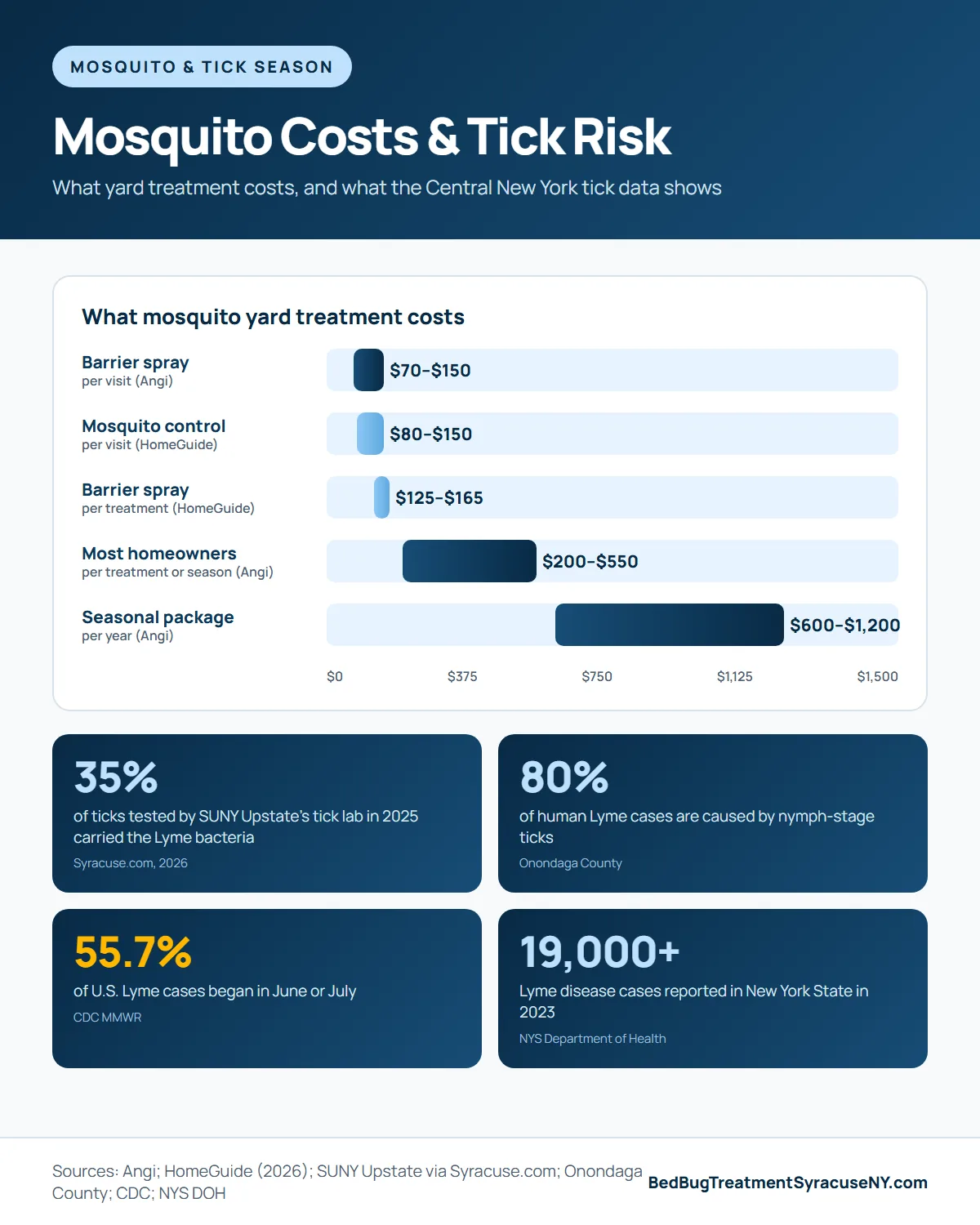
| Barrier spray, per visit | $70–$150 | Angi |
| Average mosquito control, per treatment or season | $350 (most pay $200–$550) | |
| Seasonal package, per year | $600–$1,200 | |
| Misting system install / yearly upkeep | $1,200–$2,500 / $400–$700 | |
| Mosquito control, per visit | $80–$150 | HomeGuide |
| Barrier spray, per treatment | $125–$165 | |
| How long a treatment lasts | 3–4 weeks | |
| Syracuse season, calculated (5–7 visits, June to the October freeze) | $350–$1,050 | Our calculation from Angi, HomeGuide and NOAA |
Is it worth it? For a yard next to wetlands or woods, a June-to-September plan covers the months when nights stay above 50°F. For most city lots, emptying standing water every week does more for less money. This site connects callers with bed bug providers and does not price mosquito work. The cost index linked in section 3 lists published Syracuse prices for wasps, ants, rodents and other pests.
7. Tick Season and Lyme Disease in Onondaga County
Blacklegged (deer) ticks are the tick-season story in Central New York. Unlike mosquitoes, they do not stop at the first frost. The CDC says adults may look for a host "any time winter temperatures are above freezing," and Syracuse averages a high above 32°F in every month except January. Nymphs, about the size of a pinhead, come out in early summer and cause most infections.
| Metric | Value | Source |
|---|---|---|
| Ticks tested by SUNY Upstate's lab carrying Lyme, 2019–2025 / 2025 | 32% / 35% | Syracuse.com (SUNY Upstate tick lab) |
| Ticks carrying anaplasmosis / babesiosis, 2025 | 14% / about 10% | |
| Tick submissions to the lab, 2024 to 2025 | More than doubled | |
| New Yorkers outside NYC with Lyme, 2024 vs 2022 | 18,000+ vs about 15,000 | |
| Central NY ticks carrying the Lyme bacterium | 40%–50% | Onondaga County |
| Lyme cases caused by nymph-stage ticks | About 80% | |
| NYS Lyme cases, 2023 | 19,000+ | NYS DOH |
| NYS babesiosis / anaplasmosis cases per year since 2015 | ~600 / ~1,300 | |
| Attachment time usually needed to pass Lyme | 36+ hours | |
| Onondaga Lyme rate, 2015 (latest county figure we could verify) | 27.1 per 100,000 (127 cases) | Syracuse.com (NYS DOH data) |
| U.S. people diagnosed and treated for Lyme per year | ~476,000 | CDC |
| Deer tick activity threshold | Mostly above 45°F | EPA |
| Syracuse months with a mean of 45°F or warmer | 7 (April–October) | NOAA NCEI |
Tick season in Central New York runs roughly from April through November, with a nymph peak in June and July and a second, adult peak in October. A warm January or February thaw can bring adults out too. Check for ticks after time in long grass, leaf litter or the wooded edges of parks, and remove any tick within a day; the 36-hour attachment window is the reason a daily check works.
8. Late Summer: Wasps and Yellowjackets
Paper wasp and yellowjacket colonies start in spring with a single queen and keep growing all summer. By August they are at full size and the workers are foraging hard, which is when people run into them at picnics, in lawns and around garbage cans. NPMA says stinging insects are "especially active during the second half of summer and early fall."
| Metric | Value | Source |
|---|---|---|
| Emergency room visits from stinging insects, per year | 500,000+ | NPMA |
| Peak stinging insect activity | Second half of summer and early fall | |
| Syracuse days reaching 90°F, July / August | 4.1 / 2.3 | NOAA NCEI |
| Syracuse average August high / dew point | 80.3°F / 60.2°F | |
| Wasp nest removal, national | $300–$700 | Angi |
| Wasp treatment, national | $120–$286 | Thumbtack |
| 2026 forecast for New York and New England | Warm fall may keep ticks and ants active later | NPMA Bug Barometer |
What to do: look under decks, eaves and porch railings in June and July, when nests are still the size of a golf ball. A nest found in late August, especially a yellowjacket nest in the ground or a wall void, is a job for a professional. Freezing nights kill off the workers, and Syracuse's first light frost comes around October 5.
9. Fall Invaders: Stink Bugs, Lady Beetles and Cluster Flies
September brings the biggest monthly temperature drop of the Syracuse year. The mean falls 11.6°F from September to October, and that is when a group of harmless but persistent insects starts looking for a warm wall to spend the winter in. Cornell's New York State Integrated Pest Management program names five common fall invaders in the Northeast.
| Metric | Value | Source |
|---|---|---|
| Common Northeast fall invaders | Multicolored Asian lady beetles, boxelder bugs, western conifer seed bugs, cluster flies, brown marmorated stink bugs | Cornell NYS IPM |
| Where they gather | South- and west-facing cracks and crevices | |
| Brown marmorated stink bug first U.S. record | Allentown, Pa., 1990s | |
| Syracuse mean temperature, September to October | 62.9°F → 51.3°F (−11.6°F) | NOAA NCEI |
| Syracuse mean temperature, October to November | 51.3°F → 40.5°F (−10.8°F) | |
| Median first 36°F night (light frost) | October 5 | NOAA NCEI |
| 2026 outlook for rodents, lady beetles and boxelder bugs in New York | May be delayed by a warm fall | NPMA Bug Barometer, Aug 2026 |
Why it matters indoors: fall invaders don't bite or breed inside, but they show up on warm winter days around windows and lights. They are sometimes mistaken for bed bugs. A boxelder bug nymph or a small beetle on a windowsill is a different problem from a bug in a mattress seam. If you are not sure what you found, a bed bug inspection settles it before anyone pays for the wrong treatment.
10. First Frost and the Winter Rodent Surge
The 21 million figure in the brief we started from comes from the National Pest Management Association, which says rodents "invade an estimated 21 million homes in the U.S. each winter." That is an estimate, and NPMA does not say "21+ million," so we use its wording. What sets the timing in Syracuse is the first freeze. NOAA's normals give a 50% chance of the first 32°F night by October 19 and a 90% chance by November 4.
| First fall freeze threshold | 10% chance by | Median (50%) | 90% chance by |
|---|---|---|---|
| 36°F (light frost) | Sep 24 | Oct 5 | Oct 21 |
| 32°F (freeze) | Oct 2 | Oct 19 | Nov 4 |
| 28°F (hard freeze) | Oct 16 | Nov 2 | Nov 16 |
| 24°F | Nov 1 | Nov 14 | Nov 30 |
| Rodent metric | Value | Source |
|---|---|---|
| U.S. homes invaded by rodents each winter | ~21 million | NPMA |
| Homeowners reporting mice specifically in winter | 24% | |
| Diseases spread by mice and rats | Salmonella, hantavirus; they also carry fleas, ticks and lice | |
| Gap a mouse / rat can fit through | A dime / a quarter | NPMA |
| Young per female house mouse per year | 40+ | Cornell Community IPM fact sheet |
| U.S. homes with rodent sightings in a year (2019) | 14.8 million (11.9%) | U.S. Census Bureau |
| Syracuse days with a low of 32°F or below | 132 a year | NOAA NCEI |
| Syracuse freezing nights, November / December / January | 15.5 / 25.0 / 27.7 |
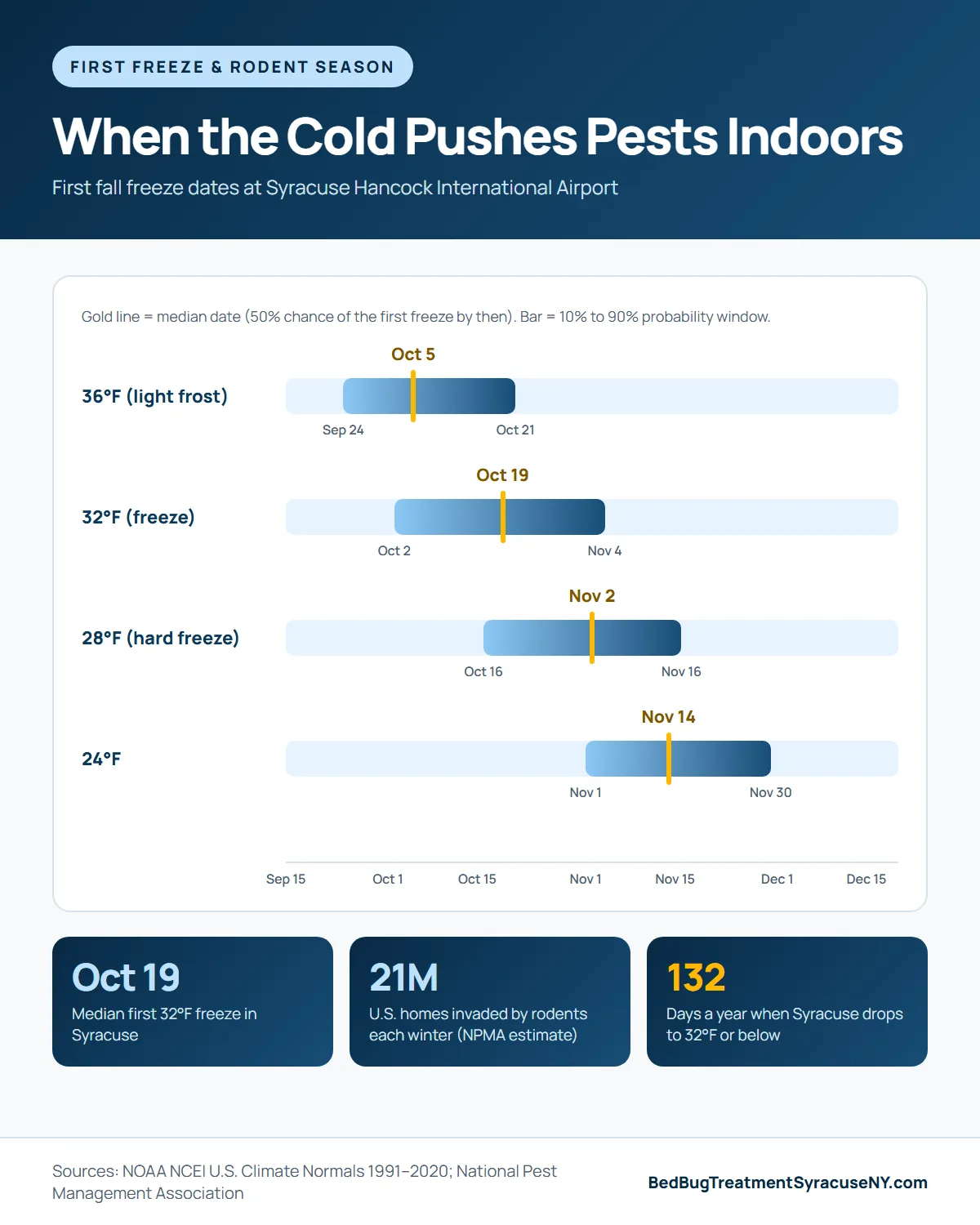
The winter rodent window: mice that get in during late October have five months of below-freezing nights to breed indoors, and each female can produce more than 40 young a year. The Census Bureau found homes with cracked walls or foundations 5.6 times as likely to report rodents, which matters in a city where much of the housing predates 1960. In a two-family house like the ones described on our Strathmore page, sealing one unit and not the other just moves the problem next door.
11. Bed Bug Seasonality in Syracuse
Bed bugs live inside, at room temperature, so Syracuse winters don't stop them and there is no off-season. Reports still rise and fall with the calendar, because people move, travel and change rooms in predictable waves. The best long-run data comes from a peer-reviewed study of Philadelphia, a Northeast city with a similar climate. Over two and a half years of city complaints, bed bug reports peaked every August and bottomed out every February.
| Metric | Value | Source |
|---|---|---|
| Bed bug report peak / low (Philadelphia, Dec 2008–May 2011) | August / February | Mabud et al., J. Med. Entomol., 2014 |
| Underlying growth in reports over the study | 4.5% a month | |
| Pest pros who say summer is the busiest bed bug season | 51% | NPMA Bugs Without Borders via PCT |
| Pros who found bed bugs in college dorms / hotels | 45% / 68% | NPMA |
| Bites as the most-reported sign of infestation | 92% | |
| Time to mature at 70–80°F with regular meals | As little as a month | University of Kentucky Entomology |
| Egg hatch at room temperature | About a week | |
| Survival without a meal at 55°F or less | Up to a year or longer | |
| Cold needed to kill bed bugs | 23°F for at least 5 days | University of Minnesota Extension |
| Heat needed to kill bed bugs | 120°F for 2 hours | |
| Syracuse University enrollment, fall 2025 | 21,922 (16,149 undergraduates) | Syracuse University |
| SU students living on campus | 53%; about 1,900 new beds due fall 2027 | Syracuse University Housing |
| SU fall 2026 move-in | Aug 17–19 new students; Aug 20–23 returning | SU Housing |
| SU 2026 commencement | May 10, 2026 | SU Commencement |
| SU Thanksgiving break / winter departure, 2026 | Nov 22–29 / by Dec 16 | SU Residential Living |
| Thanksgiving 2025 travelers (record) | 81.8 million | AAA |
| Busiest TSA day ever (Nov 30, 2025) | 3.13 million screened | Reuters |
| Syracuse, Orkin 2026 Bed Bug Cities list | #44 (up 6) | Orkin |
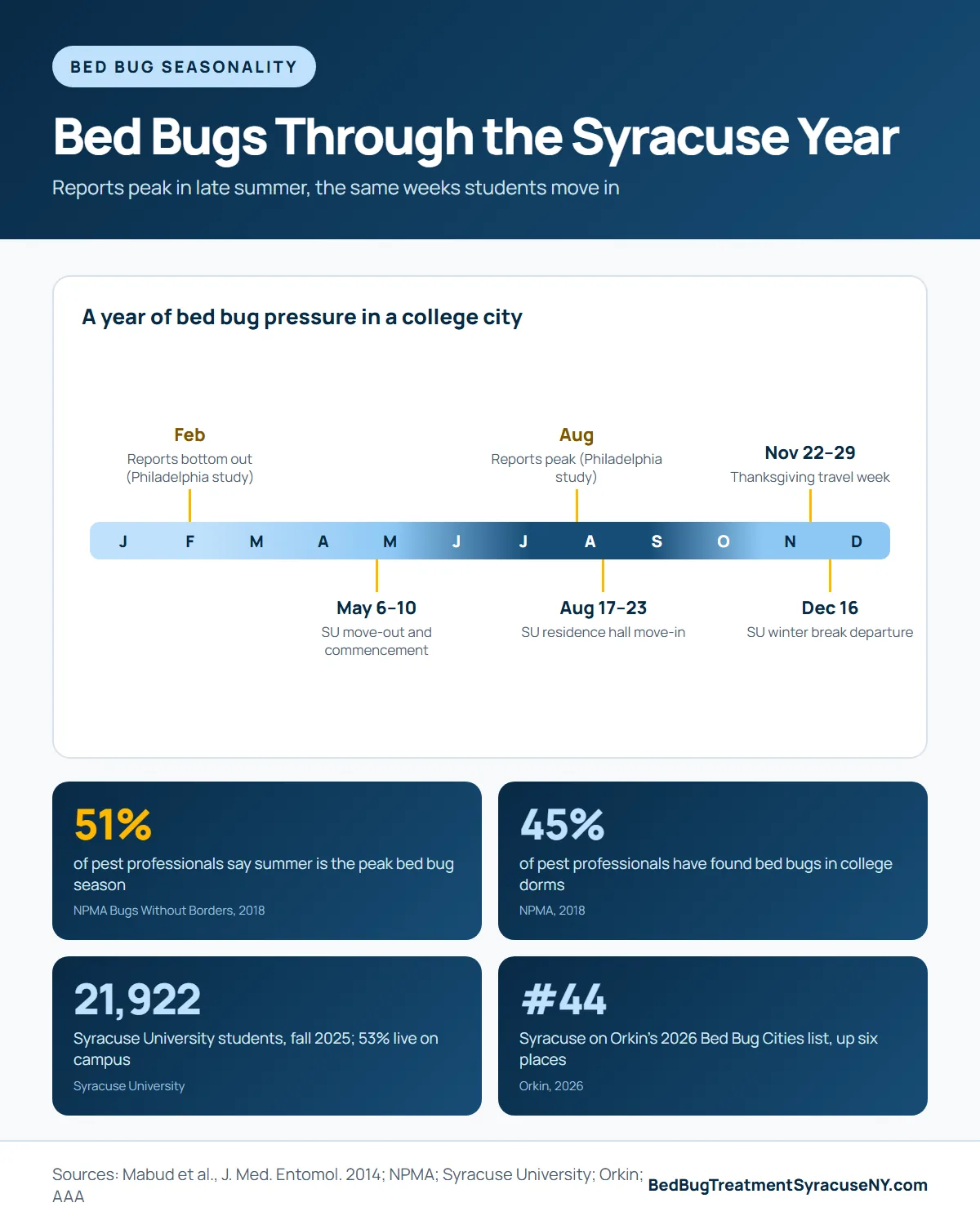
The summer surge
Summer stacks the risk factors: vacations, camps, hotel stays and the busiest moving season of the year. Indoors, a home at 70–80°F lets bed bugs grow from egg to adult in about a month, so a few bugs carried home in June can be a visible problem by August. That fits both the Philadelphia August peak and the 51% of pest professionals who name summer as their busiest bed bug season. If bites start after a summer trip, heat treatment is one way to treat the room in a single visit.
Syracuse University move-in and move-out
Syracuse University had 21,922 students in fall 2025, and 53% live on campus, about 11,600 people by our calculation. They move in over one week in August (new students August 17–19, returning students August 20–23 in 2026), right at the national bed bug peak. In May the flow reverses: residence halls closed May 6, 2026, and commencement was May 10. Move-out weeks put a lot of used mattresses and couches on the curb, and secondhand furniture is one of the ways bed bugs reach the next household. Landlords turning over student units can book an inspection between leases. Where neighboring units share walls, an apartment bed bug treatment plan looks at the units on every side.
Travel and holiday peaks
The second smaller wave is holiday travel. AAA projected a record 81.8 million Thanksgiving travelers in 2025, and TSA screened a record 3.13 million passengers on the Sunday after. Bed bugs travel in luggage, so the weeks after Thanksgiving and the winter break are a good time to check suitcases and guest beds. SU students head home for Thanksgiving (November 22–29, 2026) and leave for winter break by December 16.
Winter: indoor clustering
When the outdoor season ends, bed bugs keep going. In a heated Syracuse apartment they stay near the bed and couch, where people sleep. Turning down the thermostat does not work: the University of Kentucky notes they can survive a year or more without feeding at 55°F or lower. Leaving furniture outside isn't a reliable fix either. University of Minnesota Extension says 23°F must hold for at least five days, and a Syracuse January averages 24.1°F, with highs near 32°F. Fewer new bugs arrive in winter, which makes it a good season to clear an existing problem with chemical treatment and confirm the result with a follow-up visit.
12. A Warming Climate and Longer Pest Seasons
The normals in this post average 1991 through 2020, and the seasons they describe are moving. National analyses find more days each year that suit mosquitoes, and a tick season that grows as winters get shorter. The Northeast is among the regions changing fastest.
| Metric | Value | Source |
|---|---|---|
| U.S. cities with more mosquito disease days since 1970 | 95% of 239; +18 days on average | Climate Central, 2026 |
| Added mosquito disease days, Northeast | +20 | |
| Locations with more mosquito days, 1979–2022 | 173 of 242; +16 days on average | Climate Central, 2023 |
| Region with the largest increase in mosquito days | Northeast and Ohio Valley | |
| U.S. Lyme incidence, 1991 vs 2014 | 3.74 → 7.95 per 100,000 | EPA climate indicators |
| Effect of shorter winters on ticks | Could extend the active season | |
| Projected extra Northeast Lyme cases by 2050 (high-emissions scenario) | 23,619 (±21,607) | Couper et al., Environmental Research Letters, 2020 |
| Upstate New York Lyme cases outside NYC, 2022 to 2024 | ~15,000 → 18,000+ | Syracuse.com |
For Syracuse: expect the edges of the calendar to keep stretching, with mosquitoes into October and ticks into November and out on more winter thaw days. NPMA's 2026 fall forecast for New York already warned that a warm fall could keep ticks and ants active later and push back the indoor rodent season. The indoor bed bug calendar is set by people rather than weather, so it won't shift the same way.
Summary Table: Syracuse Seasonal Pest Statistics at a Glance
| Statistic | Value | Source |
|---|---|---|
| Syracuse January / July mean temperature | 24.1°F / 71.8°F | NOAA NCEI |
| Syracuse annual snowfall / precipitation | 127.8 in / 39.88 in | NOAA NCEI |
| Median last spring / first fall freeze | Apr 29 / Oct 19 | NOAA NCEI |
| Days a year with a low of 32°F or below | 132 | NOAA NCEI |
| Termite swarm season, New York | March–June | CCE Nassau |
| U.S. termite damage per year | $6.8 billion+ | NPMA |
| NY mosquito season | Early summer–late fall | NYS DOH |
| Onondaga West Nile human cases, 2025 | 3 | Onondaga County |
| Mosquito barrier spray per visit | $70–$150 | Angi |
| Mosquito control per visit | $80–$150 | HomeGuide |
| Syracuse barrier season, calculated | $350–$1,050 | Calculation (Angi, HomeGuide, NOAA) |
| Ticks tested carrying Lyme, 2025 | 35% | SUNY Upstate via Syracuse.com |
| NYS Lyme cases, 2023 | 19,000+ | NYS DOH |
| Lyme cases beginning in June or July | 55.7% | CDC MMWR |
| Stinging insect ER visits per year | 500,000+ | NPMA |
| U.S. homes invaded by rodents each winter | ~21 million | NPMA |
| U.S. homes with rodent sightings (2019) | 11.9% | U.S. Census Bureau |
| Bed bug report peak / low | August / February | J. Med. Entomol. |
| Pros naming summer as bed bug peak | 51% | NPMA via PCT |
| Syracuse University students, fall 2025 | 21,922 | Syracuse University |
| Syracuse, Orkin Bed Bug Cities 2026 | #44 | Orkin |
Methodology & Sources
This calendar was compiled in November 2026. All climate figures are NOAA NCEI 1991–2020 U.S. Climate Normals for Syracuse Hancock International Airport (station USW00014771), taken from the monthly, annual/seasonal and hourly normals files. Monthly humidity is our calculation from NOAA's hourly temperature and dew point normals. Day counts are sums of the monthly normals. Pest timing and statistics come from the government agencies, extension services, trade groups, peer-reviewed studies and news reports linked in each table. The pressure levels in the matrix are our editorial reading of those sources against Syracuse's temperatures, not counts of calls or cases. Several figures in the brief we started from were changed to match their sources. NPMA's rodent figure is "an estimated 21 million" homes, not "21+ million." The current NPMA termite damage figure is $6.8 billion, not $5 billion. No published source gives a $350–$700 mosquito season, so we show published per-visit ranges and our own Syracuse calculation instead. We found no primary source for a fixed termite swarm temperature. The bed bug seasonality study describes Philadelphia, not Syracuse. The latest county Lyme rate we could verify uses 2015 data, so we lead with newer state and tick-lab figures instead.
- NOAA NCEI -- U.S. Climate Normals 1991–2020
- NOAA NCEI -- Syracuse monthly normals
- NOAA NCEI -- Syracuse annual/seasonal normals (freeze dates)
- NOAA NCEI -- Syracuse hourly normals (dew point)
- NYS Department of Health -- Mosquitoes and disease
- NYS Department of Health -- West Nile and EEE, 2025
- NYS Department of Health -- Lyme disease, 2025
- Onondaga County Health Department -- Aerial spraying FAQ
- Onondaga County -- Cicero Swamp spraying, 2024
- Onondaga County -- Mosquito-borne disease news
- Onondaga County -- West Nile case, 2026
- Onondaga County Office of the Environment -- Deer ticks
- CDC -- Lyme disease facts and stats
- CDC -- Blacklegged tick surveillance
- CDC MMWR -- Lyme disease surveillance 1992–2006
- EPA -- Climate indicators: Lyme disease
- Couper et al. -- Lyme disease projections, 2020
- Climate Central -- Mosquito days, 2023
- Climate Central -- Mosquito disease days, 2026
- Syracuse.com -- Upstate tick update, 2026
- Syracuse.com -- Cicero Swamp spraying, 2019
- Syracuse.com -- Lyme rates by county, 2018
- Angi -- Mosquito control cost
- HomeGuide -- Mosquito control cost
- Angi -- Wasp nest removal cost
- Thumbtack -- Exterminator cost by pest
- NPMA -- Winter pest-proofing
- NPMA -- Rodent signs infographic
- NPMA -- Rodent guide
- NPMA -- Termite damage
- NPMA -- Stinging insects
- NPMA -- Fall & Winter 2026 Bug Barometer
- NPMA -- Bed bug facts and statistics
- PCT -- Bugs Without Borders survey, 2018
- U.S. Census Bureau -- How many American homes have pests
- Cornell Community IPM -- Mice fact sheet
- Cornell Cooperative Extension Nassau -- Termites
- Cornell -- Eastern subterranean termites fact sheet
- NC State Extension -- Eastern subterranean termites
- Cornell Cooperative Extension Rockland -- Carpenter ants
- Cornell NYS IPM -- Fall invaders
- Mabud et al. -- Bed bug seasonality, J. Med. Entomol. 2014
- University of Kentucky -- Bed bugs (ENTFACT-636)
- University of Minnesota Extension -- Bed bugs
- Orkin -- 2026 Bed Bug Cities list
- Syracuse University -- Enrollment
- Syracuse University -- Housing
- Syracuse University -- Move-in information
- Syracuse University -- Commencement 2026
- Syracuse University -- Residential break information
- AAA -- Thanksgiving travel forecast 2025
- Reuters -- TSA record travel day, 2025
Frequently Asked Questions
What are the most common pests in Syracuse, NY?
It depends on the season. Spring brings termite swarmers and carpenter ants, summer brings mosquitoes, ticks and wasps, fall brings stink bugs, lady beetles and cluster flies, and winter brings mice. Rodents are the most widespread household pest in federal data: 11.9% of U.S. homes saw them in a year, more often in the Northeast (U.S. Census Bureau). Bed bugs are active all year indoors, and Syracuse ranks #44 on Orkin’s 2026 Bed Bug Cities list.
When is mosquito season in New York and Syracuse?
The NYS Department of Health says mosquitoes are active from early summer until late fall, and Onondaga County advises protection until the first frost. In Syracuse that means roughly late May into October. Average lows top 50°F from June through September, and the median first freeze is October 19 (NOAA). West Nile risk is highest in August and September.
When is tick season in Central New York?
Blacklegged ticks are active in spring, summer and fall, and the CDC says adults look for hosts any time winter temperatures are above freezing. Nymphs peak in early summer and cause about 80% of Lyme cases (Onondaga County). 55.7% of U.S. Lyme cases begin in June or July (CDC). In 2025, 35% of ticks tested by SUNY Upstate carried the Lyme bacteria.
When do termites swarm in Syracuse?
Cornell Cooperative Extension puts New York termite swarms between March and June, usually on warm days after rain. Those dates come from downstate New York. Syracuse warms later, with average highs of 56°F in April and 69°F in May, so most local swarms fall in that April-to-June stretch.
How many homes do rodents invade in winter?
The National Pest Management Association estimates rodents invade about 21 million U.S. homes each winter, and 24% of homeowners report mice specifically in winter. In Syracuse the trigger is the first freeze: NOAA gives a 50% chance of the first 32°F night by October 19 and a 90% chance by November 4.
How much does mosquito barrier spray cost?
Angi lists barrier spray at $70 to $150 per visit, with most homeowners spending $200 to $550 per treatment or season and seasonal packages at $600 to $1,200 a year. HomeGuide lists $80 to $150 per visit, and treatments last 3 to 4 weeks. Covering a Syracuse season from June to the October freeze takes about 5 to 7 visits, or roughly $350 to $1,050 by our calculation.
Are bed bugs seasonal in Syracuse?
Bed bugs live indoors and stay active all year, but reports follow people. A peer-reviewed Philadelphia study found reports peaked in August and bottomed out in February, and 51% of pest professionals say summer is their busiest bed bug season. In Syracuse, August is also when Syracuse University students move in, and holiday travel adds a smaller wave in late fall.
When is the first frost in Syracuse?
NOAA’s 1991-2020 normals for Syracuse Hancock International Airport put the median first 36°F night on October 5 and the median first 32°F freeze on October 19. The median last spring freeze is April 29, which leaves about 173 days between them.
Found Bugs Indoors, Whatever the Season?
Mosquitoes and wasps come and go with the weather, but bed bugs don't. Call the referral line and you will reach an independent provider that works in Syracuse. They can check whether what you found is a bed bug, a fall invader or something else, and explain the options and the cost in writing. Nothing has to be booked, and the decision stays with you. The service areas page lists the neighborhoods covered.